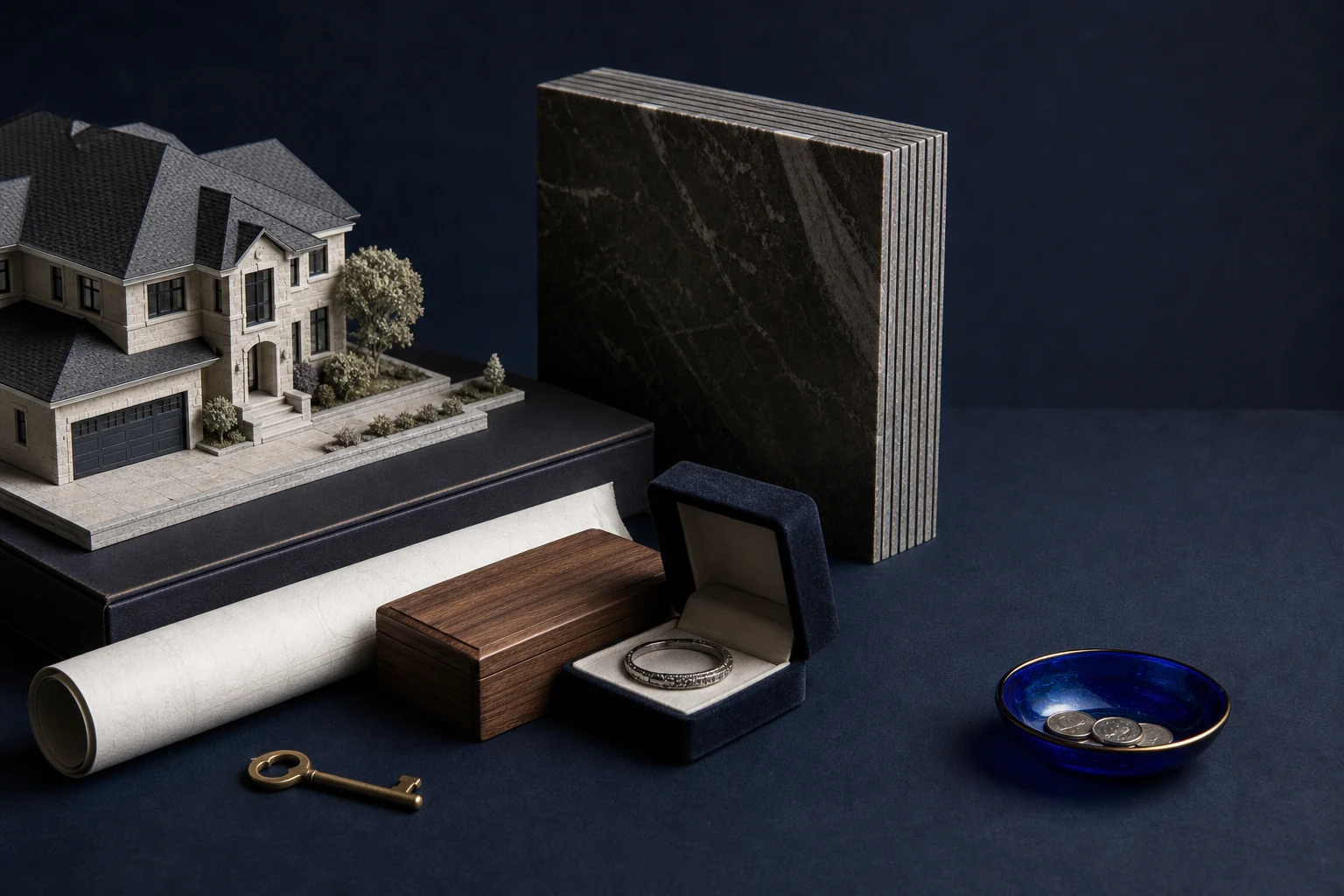
Most people know the estate pays some tax. Fewer have seen the mechanics laid out, and the mechanics decide whether your family inherits your assets or inherits the job of selling them.
The deemed disposition
On the day you die, the tax system treats you as having sold everything you own at fair market value. Your investment portfolio, your rental property, the cottage, your private company shares: all deemed sold, all at once, on your final tax return.
Half of each capital gain is taxable, and because everything lands in a single year, most of it lands in the top bracket. A cottage bought decades ago for $200,000 and worth $1,200,000 today carries a $1,000,000 gain; roughly $250,000 of tax arrives with it. Private company shares are often the largest single item, because their cost base can be close to zero.
Registered accounts are treated differently, and worse. An RRSP or RRIF does not get capital gains treatment: the entire remaining balance is added to the final return as ordinary income. An $800,000 RRIF can produce over $400,000 of tax on its own.
There are two big deferrals. Assets rolling to a surviving spouse defer everything until the second death, and the principal residence stays exempt. Neither one removes the bill. The spousal rollover concentrates it, so at the second death everything lands together.
Probate, on top
Before the estate can move most assets, Ontario charges Estate Administration Tax, roughly 1.5 per cent of estate value above $50,000. It is smaller than the income tax bill, but it is calculated on gross value, not gains, and it is due early in the process, when the estate is least liquid. A $4,000,000 estate pays about $59,000 before it can release anything.
Assets with named beneficiaries, including life insurance and registered accounts with designations, pass outside the estate and skip probate entirely. That is one reason insurance shows up so often in estate plans: it is frequently the only large asset that arrives quickly, tax-free, and without waiting for the court.
The assets are the wrong shape
Add it up for a typical successful family: mid six figures of tax on the final return, probate on top, and the assets standing behind those bills are a business, a property, and a portfolio. The estate is wealthy and illiquid at the same time. Executors in that position have three options: sell assets on the estate’s timeline rather than a good one, borrow against the estate, or use liquidity that was arranged in advance.
That third option is what estate liquidity planning means. A permanent policy sized against the projected final tax bill pays out when the bill arrives. The tax bill grows with your assets, and the death benefit is the only funding instrument guaranteed to pay at the event that triggers the bill.
For example, a couple holding a $3,000,000 investment portfolio, a $1,200,000 cottage, and $900,000 in RRIFs might project a combined final tax and probate bill in the range of $1,100,000 at the second death. A joint last-to-die permanent policy in that amount converts an unpredictable forced sale into a known annual premium the couple can budget for today.
Where to start
Start with the projection: what would the bill be if the second death happened this year, and what will it be at life expectancy given how the assets are growing? We build that projection with clients, alongside their accountant where there is one, and only then talk about which funding tool fits. Sometimes the answer is insurance. Sometimes it is restructuring ownership, updating designations, or simply knowing the number and choosing to accept it.
This article is general information, not tax or legal advice. Figures are simplified illustrations; your numbers depend on your assets, province, and the rules in force at the time.